
Brunello Cucinelli
From the Umbrian countryside to the world of fragrance
What do philosophy, a medieval village in Umbria and Italian perfumery have in common? The answer is Brunello Cucinelli – a design house where people, nature and beauty have always been given more space than the pursuit of the next trend. So when the brand stepped into the world of fragrance, its perfumes became something more than just another accessory. They became a new way of telling the same story.
Summary
-
Brunello Cucinelli founded his company in 1978 and has built the brand around Italian craftsmanship, nature and his philosophy of “humanistic capitalism”.
-
The village of Solomeo in Umbria is both the company's home and a central source of inspiration – something that also shapes the brand's fragrances.
-
The fragrance collection was introduced in 2023 with Pour Homme and Pour Femme and has since expanded with the poetic Incanti Poetici collection.
Some fashion houses build their worlds around logos. Brunello Cucinelli has built his around a village.
Solomeo is the cultural and spiritual heart of Umbria, an architectural gem nestled amongst the rolling hills of central Italy. It is here that Cucinelli not only has set his roots for his company, but has also, over the decades, restored the medieval village and created spaces for craftsmanship, culture and work.
This is also where we find the key to the brand's fragrances. Cypress, earth, wood, sunlight, spices and the Umbrian landscape recur throughout the perfumes. Even the feeling of cashmere – the material that first made Brunello Cucinelli famous – has found an olfactory counterpart.
The philosopher who started with cashmere
Brunello Cucinelli was born in 1953 and grew up in a farming family outside Perugia. His childhood unfolded among fields, fruit trees and forests, in a life where the family remained close to nature. But another experience would prove equally important to his future.
When his father left farming to work in a factory, the young Brunello saw how work could strip a person of their dignity. His father's experiences left a profound impression and later became one of the foundations of what Cucinelli calls humanistic capitalism: a company should be allowed to make money, but never at the expense of people.
It may sound more like philosophy than business economics. That is also part of the point. Over the years, Cucinelli has frequently referred to philosophers such as Kant, Socrates and Marcus Aurelius. So when he began working with coloured cashmere in 1978, his ambition was not simply to create beautiful clothes. He wanted to build a company where craftsmanship, beauty and profitability could coexist with respect for the people actually doing the work.
Solomeo – more than an address
In 1985, the company moved to Solomeo, the medieval village where his wife Federica grew up. Over time, the place became increasingly intertwined with both the company and Cucinelli's own philosophy.
Old buildings were restored. A theatre was built. Craftsmanship and traditional skills were given spaces of their own. Cucinelli prefers to describe himself as the temporary custodian of the place rather than its owner – the idea is to leave behind something that can outlive both the individual and the company. This belief that craftsmanship should be passed on also helps explain why Brunello Cucinelli has never really been about fleeting trends.
When Solomeo became a fragrance
Work on Brunello Cucinelli's first fragrances began in 2019 together with the Italian fragrance company EuroItalia. Four years later, Pour Homme and Pour Femme were unveiled – two fragrances created to translate Cucinelli's world into something that cannot be seen or touched.
Perfumer Olivier Cresp drew inspiration for Brunello Cucinelli Pour Homme from the rows of cypress trees set against the blue sky around Solomeo. Bergamot and spices bring light and air to the composition before cypress, juniper and aromatic green notes take over. Woods and warm amber notes anchor the fragrance in the landscape.
Pour Femme was created by Daphné Bugey from a different starting point: the sensation of Cucinelli's cashmere. Citrus and pink pepper meet orange blossom and an unusual chestnut accord before cedarwood, vetiver, incense and musk give the composition a softer weight.
What is interesting is that neither fragrance tries to smell like “fashion”. Instead, they attempt to capture a place and a feeling. Pour Homme is the cypress trees and the landscape. Pour Femme is the colours, the materials and the soft sensation of cashmere against the skin.


Incanti Poetici – when fragrance becomes poetry
The next chapter took the idea considerably further. With the Incanti Poetici fragrance collection – roughly translated as “poetic enchantments” – the perfumes became freer and more emotional. Here, it is less about a traditional fragrance for men or women and more about moments, nature and states of mind.
The first six compositions – Vie Eteree, Soffio Zenit, Sogno Notturno, Brezza Gentile, Ombra Lirica and Vento Ardente – move through different interpretations of light, air, earth, wood and warmth. Their names sound almost like fragments of a poem, and that is no coincidence. Cucinelli himself describes the collection as a meeting between the art of poetry and the art of perfumery.
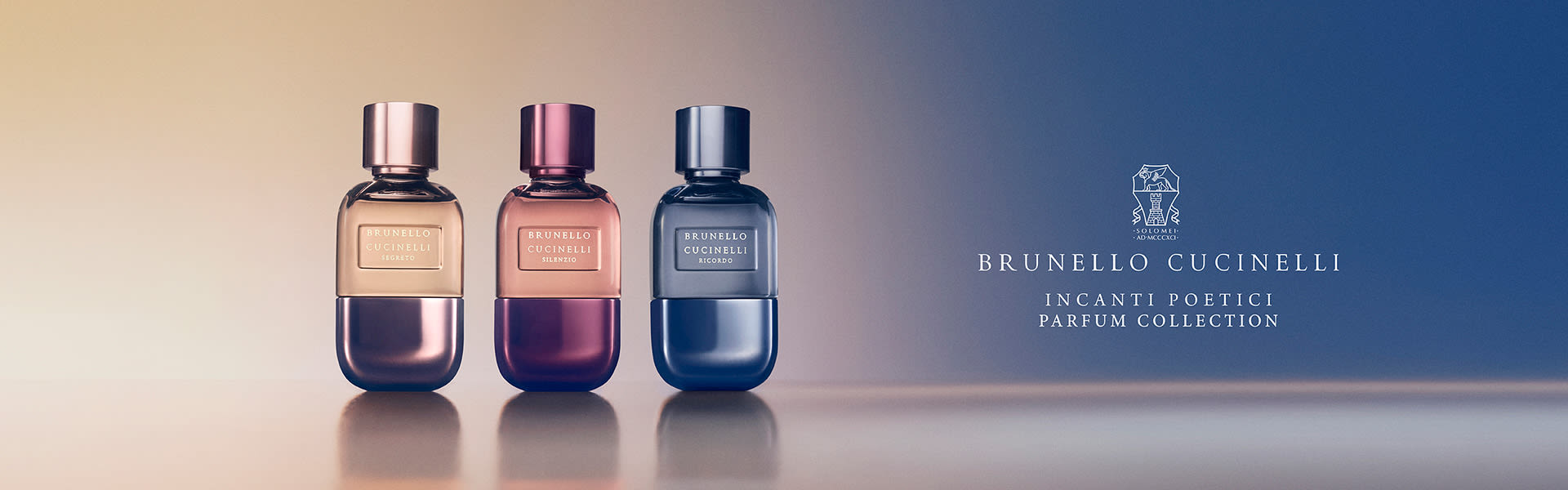
Later, Segreto, Silenzio and Ricordo continued the story. Three different interpretations of Brunello Cucinelli's poetic fragrance universe, where citrus and floral notes meet spicy and woody nuances, yet all share the same underlying idea: a perfume should evoke a feeling rather than simply present a collection of notes.


The scent of a philosophy of life
It is easy to dismiss philosophy as beautiful words when it is used by a company. With Brunello Cucinelli, that becomes more difficult, because the same ideas have followed him throughout most of his working life. Human dignity, respect for nature, the importance of craftsmanship and the belief that beauty has a value of its own can be found everywhere.
And perhaps that is precisely why the fragrances feel like such a natural extension of the house. Scent, after all, is closely connected to memory, nature and place – three things that continually return in Cucinelli's own story.
From the cypress trees around Solomeo to chestnut, wood, incense and the more dreamlike compositions of Incanti Poetici, the same ambition remains: to create something that does not need to shout to be noticed.
Brunello Cucinelli started with cashmere. Almost fifty years later, his world has found its scent.